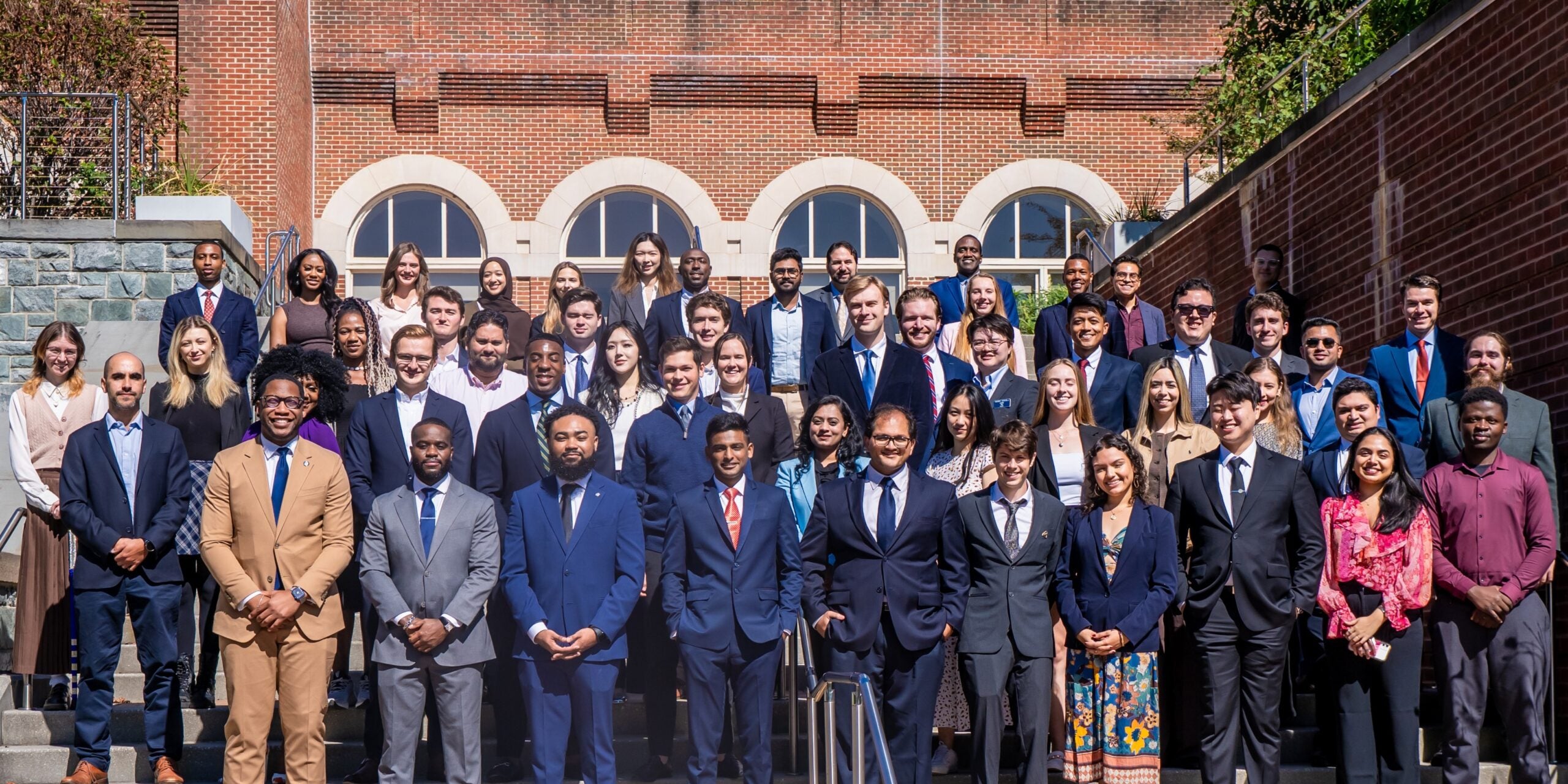
Building Futures, One Conversation at a Time: GradGov’s Mentorship Program Opens Its Third Year
By Amaya Ashanti Brown
The third annual GradGov Mentorship Program began quietly, with students checking in, finding their tables, and greeting the mentors who would guide them through the year ahead. What started as a simple gathering soon became a room filled with intention. Conversations grew warmer, introductions deepened, and the purpose of the evening became clear. This was not just another event. It was the start of a community built on guidance and possibility.
For Joe Wang, the External Relations Director who led the planning, the night felt like a release of months of work. He spent nearly three months reaching out to mentors across LinkedIn and past cohorts, coordinating finances, and building meticulous seating charts. It was not simple. “Funding was chaotic and outreach was chaotic,” he said with a laugh. “But once we secured around thirty mentors, everything started coming together.” He made sure each student would sit with someone who could support their goals, even if their assigned mentor could not attend. “I wanted everyone to take something meaningful from tonight.”
GradGov President Kavin Sakthivel understood that feeling. He once arrived at Georgetown unsure of his path, and it was mentorship that helped him find direction. “I was a confused student two years ago,” he said. “Mentorship is what helped me figure out who I am.” He sees the program as one of GradGov’s most important efforts, especially in a shifting job market. “When things are uncertain, students need guidance more than ever. This program brings together students from all eight graduate schools. Only GradGov can do that.”
VP of Engagement Melissa supported the event from behind the scenes, managing administrative coordination, finances, and communication. She said the program works because it connects academic theory with the reality of working in Washington. “Students want to know how to present themselves and how to understand professional spaces,” she said. “A year-long pairing gives them the time to grow and build confidence.”
Among the mentors this year is Deeksha, who remembers exactly how overwhelming the job search felt during her own graduate studies. Now a researcher in developmental disorders, she joined because she wanted to offer the kind of support she once needed. “I want to help with the things I wish I knew back then,” she said. “Grad school is a short timeline with a lot of pressure. Having someone who has been through it makes a difference.”
Her mentee, Dena, hopes the program will help her expand her world beyond the intensity of her biophysics program. She came looking for new ideas, new people, and exposure to different parts of the science community. “My main goal is to expand my horizons,” she said. She also wants to understand fields she has not yet explored, including biotech and biochemistry. When asked what
she looks for in a mentor, she answered simply. “A positive influence who can provide guidance.”
Near the end of the evening, the room grew quieter as attendees listened to remarks. Remarks were spoken about the different kinds of students. The ambitious and overwhelmed. The deeply caring. The confused. “Confusion is not failure,” she told the room. “It is the beginning of progress. A mentor will not remove the fog, but they will show you how to walk through it.”
As the night wound down, conversations that began as small introductions were already turning into something deeper. Students stayed at the tables long after the program ended, still talking, still learning from one another.
When asked what he hopes students carry forward, Joe offered a reminder that feels true far beyond this event. “People are willing to help if you are willing to ask,” he said. “No one has to do this alone.”
As the tables emptied and the last conversations faded into the hallway, it was clear the program had already done its work. The evening was not just an introduction but the start of a year shaped by guidance, growth, and community. For many of the students who showed up unsure of what to expect, the night ended with something simple but powerful. They now had someone in their corner.