Graduation, Between the Moment and What Comes Next
By Amaya Ashanti Brown
For many students, the milestone arrives with pressure, rising costs, and no clear path forward.
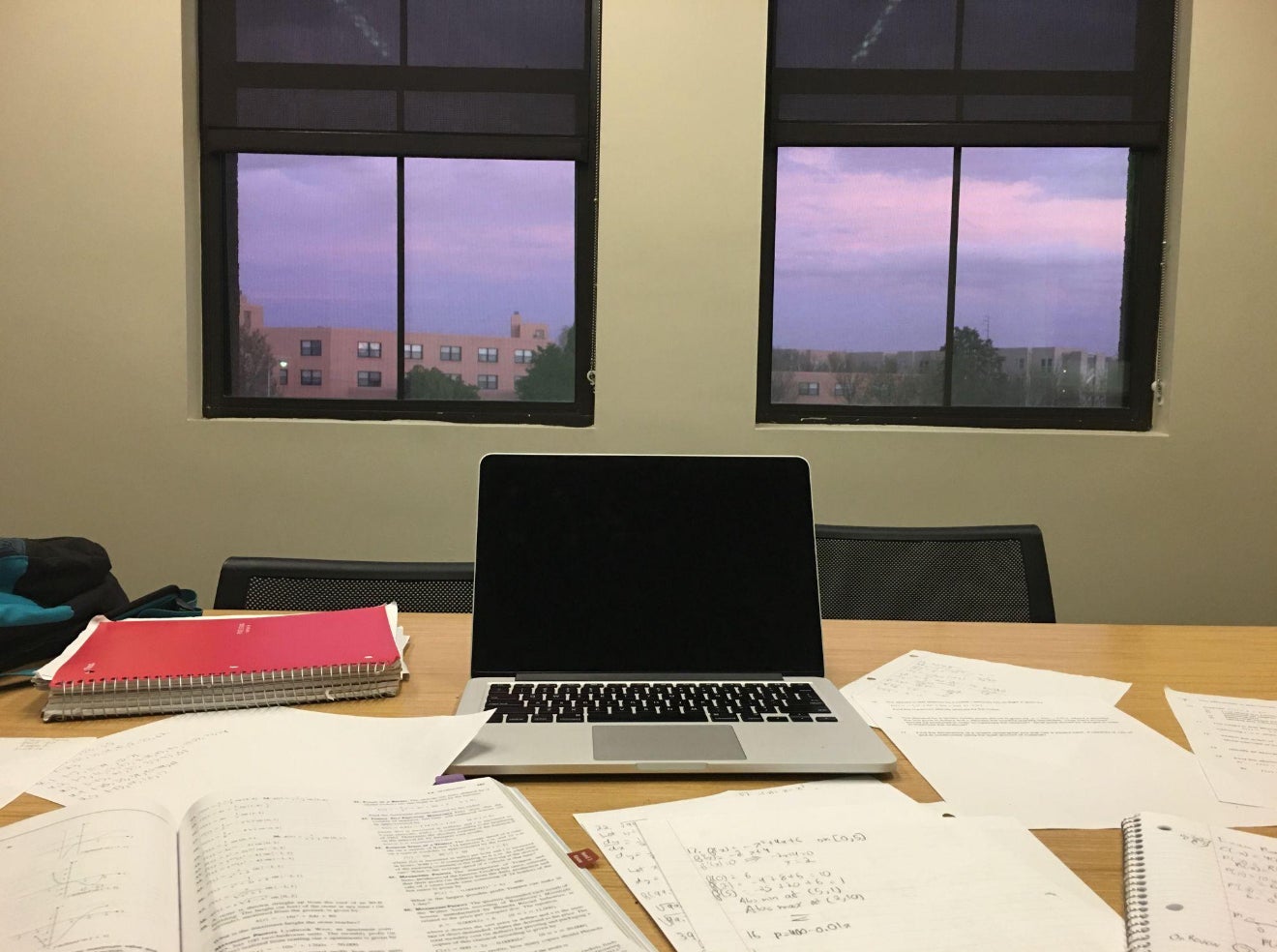
On the top floor of 55H, the space stretches wider than it first appears, running from a small gym into an open study area that should hold more people than it does. A few students move through sets in the gym, but in the study space, only three are spread across the entire floor. One sits with her headphones in, papers covering the table in front of her, six different things laid out as if she has been there for hours and plans to stay longer. Another speaks in a steady, measured tone, mid-interview, her voice carrying just enough to be heard across the room.
A few steps away, Joe Wozniak, a graduate student in the Master of Government Democracy and Governance program, sits with his laptop open, finishing his final.
“I’m just trying to figure out my next move,” Wozniak said. “It’s a tough job market.”
He calls it “cautiously optimistic,” a phrase that holds together two things that do not fully settle. Tabs move between LinkedIn and Handshake. Applications go out. Responses do not come back right away. Finishing school has a clear end point. What comes after does not.
Among college graduates ages 22 to 27, the unemployment rate stands at 5.6 percent, compared to the overall rate of about 4 percent (Federal Reserve Bank of New York, 2026; Ember, 2026). Even among those who are working, about 42 percent are in jobs that do not typically require a college degree (Federal Reserve Bank of New York, 2026). That gap sits directly in the space students are entering, where the expectation of stability arrives before the reality of it does.
That number has appeared before, but the moment surrounding it has changed. In 2016, the unemployment rate for recent graduates was also 5.6 percent, and about 44 percent were underemployed (Economic Policy Institute, 2016; Federal Reserve Bank of New York, 2016). At the time, hiring was expanding after the recession, and there was a sense that opportunities would continue to open. Now, hiring has slowed again, and the space between graduating and stabilizing has stretched longer.
Wozniak keeps applying anyway, refreshing pages, checking for updates, staying in motion even when the results are not immediate.
Across the city, that same moment takes a different shape. On a bus headed toward campus, with traffic moving slowly past the window, Nemata Kabba, a graduate student in the Integrated Marketing Communications program, describes what graduation feels like from her side of it.
“I’m proud of myself,” Kabba said. “But I’m also nervous.” That balance shifts quickly once conversations begin.
“People ask me, ‘Do you have a job?’” she said. “I’m still looking.”
“People are looking,” she said. “They want to know what you’re doing next.”
There is no pause between finishing and explaining what comes after. The expectation arrives immediately, even when the answer is still forming. The degree is earned, so the next step is supposed to be clear.
Kabba also described a broader sense of imbalance in who gets access to opportunities and how students move through them.
“Some people come in with connections already,” she said. “For others, you have to prove that you belong.”
Even when opportunities come through, they do not always match what students expected when they started. About 42 percent of employed graduates are working in jobs that do not require a college degree (Federal Reserve Bank of New York, 2026), a pattern that continues to shape how early careers take form.
At the same time, the cost of stepping into that next phase has been building for years. A District of Columbia report tracking the apartment market from 2000 to 2015 shows that rent increased steadily across that period, driven in part by population growth and demand from younger residents (Office of the Chief Financial Officer, D.C., 2015). By 2018, Washington, D.C. was identified as one of the most expensive rental markets in the country (Washingtonian, 2018). More recent housing data continues to show that rental costs in the District remain significantly higher than national averages, placing added pressure on recent graduates entering the workforce (Zillow, 2026).
Now, those long-term pressures meet students at the exact moment they are expected to move forward.
“It’s been a lot,” Kabba said.
Housing does not wait. Move-out dates come before job offers. Security deposits come before first paychecks. In a city where rent has climbed for more than a decade, that gap becomes something students have to manage immediately, not eventually.
Back on that top floor, Wozniak shapes his version of graduation around what is realistic right now. The version people expect does not quite match what he can do.
“I’m planning on making reservations for graduation day,” he said. Dinner with his parents. Something simple. Something that fits.
Graduation is often imagined as a moment that arrives fully formed, a clear transition from one stage to the next. But most of what defines it does not show up in photos or announcements. It shows up in quieter decisions, in what gets postponed, what gets scaled back, and what never makes it into the visible version of the moment at all.
“Looking at her, I would have thought everything was fine,” Kabba said, reflecting on her thoughts about a previous student who seemed to have it together on the outside then shortly had the realization she was facing challenges as well.
From the outside, it often does.
The degree is still earned. The work is still done. The pride is still there. That part has not changed. What has changed is what students are stepping into, and how long it takes to find their footing once they get there.
Wozniak is still applying. Kabba is still moving forward, still planning, still figuring it out in real time. The uncertainty does not stop them from showing up to what comes next. It just means they are stepping into it without the guarantees they were told to expect.
In a labor market where 5.6 percent of young graduates are still looking for work, where about 42 percent of those employed are working in jobs that do not require a college degree, and where housing costs in Washington remain among the highest in the country (Federal Reserve Bank of New York, 2026; Zillow, 2026), the path forward is not always immediate or clear.
But it is still moving.
Graduation does not arrive as a clean ending. For many students, it arrives in the middle of something that is still unfolding, and they step into it anyway, building what comes next while they are already inside it.